Guide
Datacenter vs Residential Proxies: Which One Do You Actually Need? (2026)
A practical breakdown of datacenter vs residential proxies, including speed, detection risk, cost, and use cases for scraping pipelines in 2026.
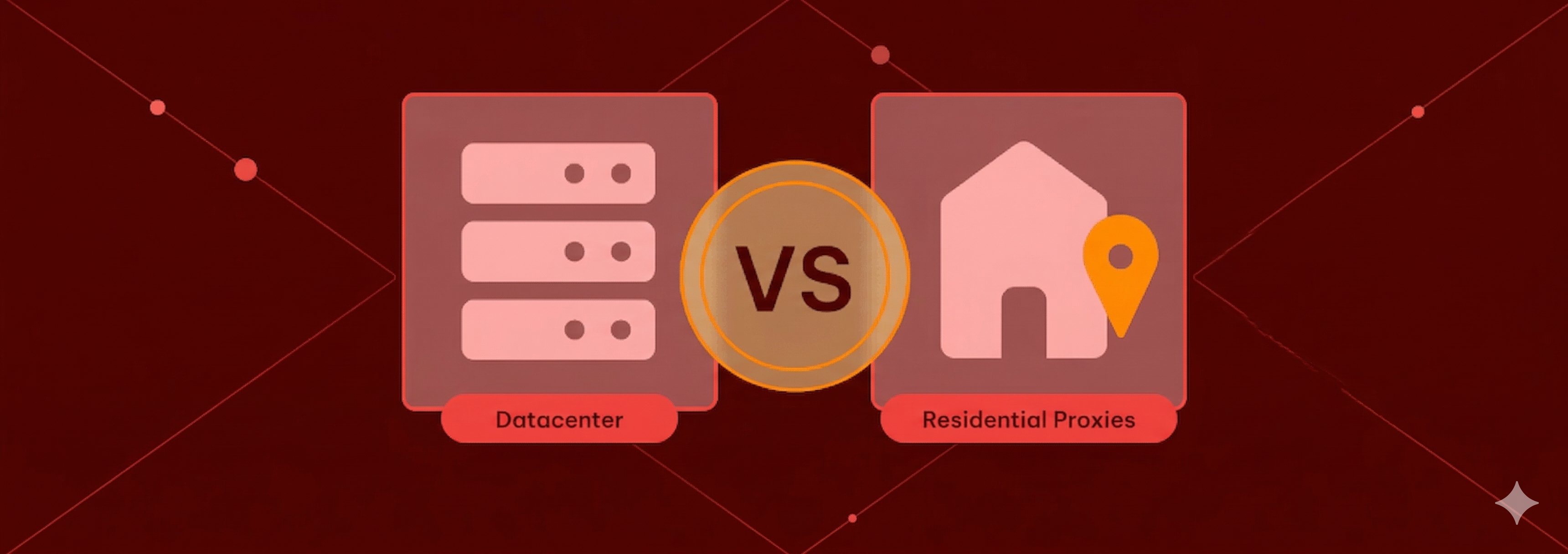
The Choice That Makes or Breaks Your Data Pipeline
Your scraper is running. Requests are getting blocked. Data collection has ground to a halt. The culprit may be the proxy type.
This decision matters more in 2026 because modern anti-bot systems use fingerprinting, TLS analysis, IP reputation, and behavioral tracking to spot datacenter traffic quickly.
What Are Datacenter Proxies?
Datacenter proxies funnel traffic through servers housed in commercial data centers.
Speed: often under 100ms.
Cost: often $0.10-$1 per IP.
Detection risk: high on protected sites because IP ranges are catalogued.
Pool size: smaller but focused.
Datacenter proxies work when speed matters more than stealth: public APIs, government datasets, internal testing, and lightly protected sites.
What Are Residential Proxies?
Residential proxies channel requests through actual devices on genuine ISP networks.
Anonymity: strong because the IPs are ISP-assigned.
Success rates: high on heavily protected sites when rotation is configured correctly.
Response time: usually slower than datacenter proxies.
Pool size: millions of IPs distributed globally.
Cost: bandwidth-based pricing.
Residential proxies dominate when you need to access protected sites, geo-blocked content, ad placements, or e-commerce data.
Head-to-Head Breakdown
| Factor | Datacenter | Residential |
|---|---|---|
| Speed | Very fast | Moderate |
| Detection risk | High | Low |
| Cost structure | Per IP | Per GB |
| Best use cases | Public data and APIs | E-commerce, social, geo-targeted data |
| Pool size | Thousands | Millions |
| Setup complexity | Simple | Rotation and targeting options |
When Datacenter Proxies Make Sense
Use datacenter proxies for public APIs, academic datasets, internal load testing, basic rate-limited sites, and real-time applications where latency is the main constraint.
When Residential Proxies Are Essential
Use residential proxies for social media platforms, e-commerce scraping, geo-restricted content, market research, ad verification, and financial data sources with anti-bot systems.
The Smart Hybrid Strategy
Many teams test with datacenter proxies first, then move production scraping to residential IPs once target protections are understood. Keep datacenter proxies for public reference data and use residential IPs for protected targets.
Making the Right Call
Heavily protected targets usually require residential proxies. Public or lightly protected sources often work with datacenter proxies. Budget-conscious teams should calculate cost per successful request, not just cost per request.
FlameProxies offers residential and datacenter options with residential access starting at $0.50/GB. Use code LAUNCH10 for 10% off your first order at flameproxies.com.