Guide
Residential Versus Mobile Proxies: Which Fits?
Compare residential versus mobile proxies by IP source, stability, targeting, speed, cost, and use case to choose the right network for your workload.
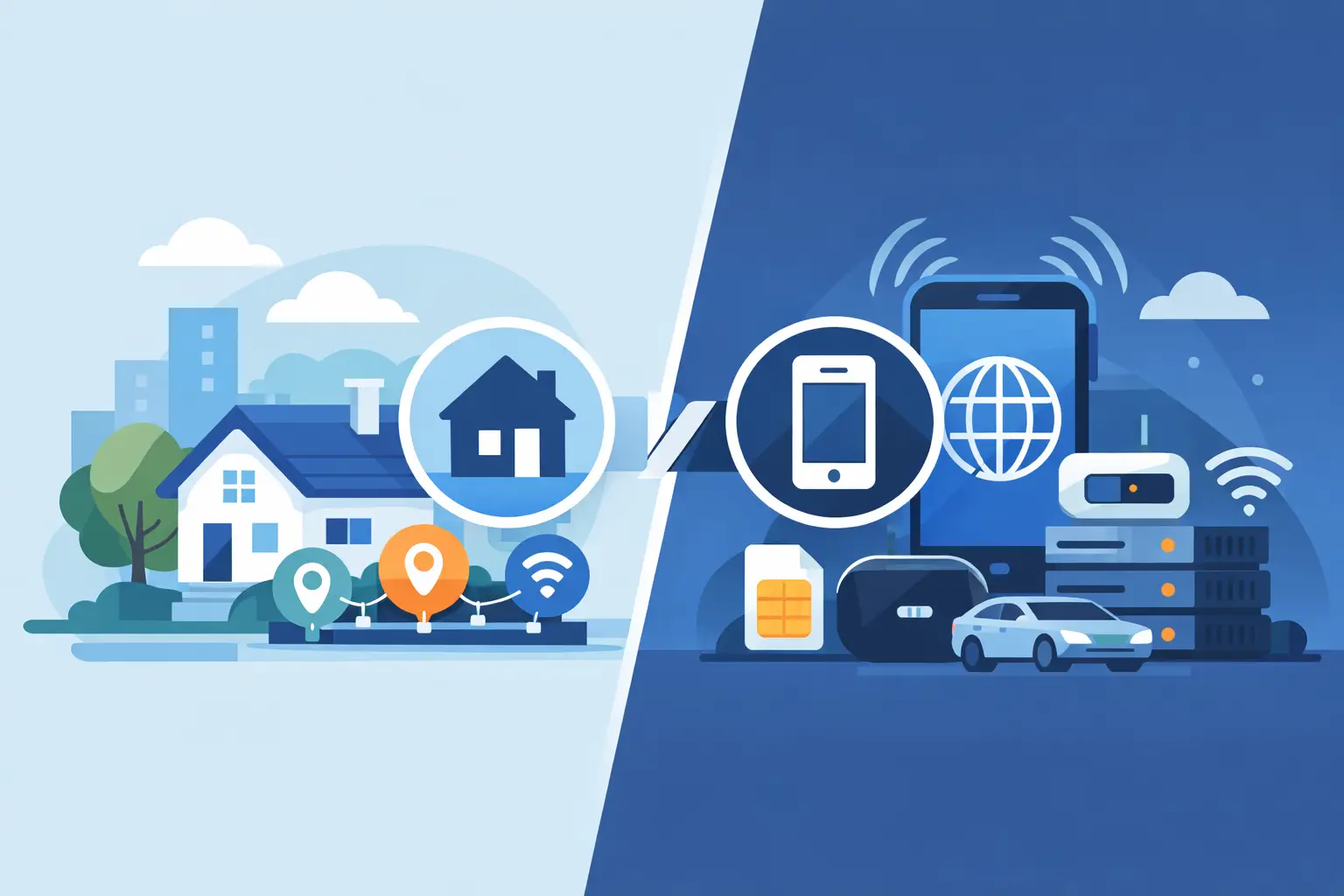
A blocked request has a cost. It can leave an e-commerce price monitor incomplete, distort an ad verification report, or slow a data pipeline that needs results now. The decision between residential versus mobile proxies determines how your traffic appears to target sites, how much control you retain, and what you pay to operate at scale.
Both proxy types route requests through real-user IP addresses rather than server-hosted addresses. That shared characteristic makes them useful for tasks where a datacenter IP may face tighter restrictions. Their operating models are different, however. Choosing based on a vague idea that one is more "premium" than the other can create unnecessary cost or limit throughput.
Residential Versus Mobile Proxies: The Core Difference
Residential proxies use IP addresses assigned by internet service providers to household connections. A request sent through one of these IPs looks like it originates from a home broadband user in a specific city, state, or country, depending on the available targeting level.
Mobile proxies use IP addresses assigned by cellular carriers. The traffic appears to come from a phone, tablet, hotspot, or other device connected through a 3G, 4G, or 5G network. Carrier-grade network address translation often means many real devices can share the same public mobile IP.
That distinction affects reputation, session handling, location precision, bandwidth economics, and available supply. Neither category is automatically better. The right choice depends on the target platform, request volume, and the cost of a failed request.
Why Mobile IPs Can Be Treated Differently
Web platforms see enormous volumes of legitimate activity from mobile carrier networks. Because carrier IPs are shared and can change frequently, blocking a single mobile IP can risk affecting many genuine users. Some platforms therefore apply more tolerance to mobile-originated traffic than to other network types.
This does not mean mobile proxies bypass every control. Modern anti-bot systems examine much more than an IP type. They can evaluate request rate, browser behavior, cookie consistency, device signals, account history, headers, and the sequence of actions taken during a session. A mobile IP paired with aggressive automation is still aggressive automation.
Mobile networks also introduce variability. Cellular routing can change, latency can fluctuate, and a mobile IP may geolocate to a carrier gateway rather than a precise user neighborhood. For work that needs stable, repeatable sessions or highly specific city targeting, those trade-offs matter.
Where Residential Proxies Have the Advantage
Residential networks are usually the more flexible option for broad web data collection and geographically distributed access. Their larger IP pools make it easier to rotate addresses across countries and, in some cases, states or cities. This is useful when an operation needs to see localized search results, retail pricing, travel inventory, or regional content at scale.
A residential proxy pool also gives operators a practical balance between reputation and availability. You can rotate IPs request by request for high-volume collection, or maintain sticky sessions when a workflow requires cookies, cart state, login continuity, or multi-step navigation.
For example, a retailer tracking competitor pricing across 20 markets needs coverage and volume more than a cellular carrier identity. A residential network is generally the cleaner fit. An SEO team checking localized rankings has similar requirements: country and city selection, rotation controls, and enough bandwidth to run recurring checks without overpaying for each request.
Residential proxies are also easier to align with ordinary browser and automation workflows. They support a wide range of use cases, including market research, ad verification, lead generation, brand monitoring, QA testing, and privacy-focused browsing. The goal is not to force one network into every job. It is to use an IP source that matches the workload's access pattern.
Where Mobile Proxies Make Sense
Mobile proxies are most useful when a target is highly sensitive to network reputation and the workflow benefits specifically from a carrier-originated connection. This can apply to certain mobile-first platforms, app testing scenarios, or account workflows where traffic normally comes from cellular networks.
They can also be a reasonable choice for low-to-moderate-volume tasks where the value of each successful session is high. If a workflow involves a small number of difficult sessions, paying more for mobile access may be justified. The calculation changes quickly when the job requires millions of pages, frequent rotations, or large media-heavy responses.
Mobile supply is typically smaller and more expensive than residential supply. Operators should treat it as a specialized resource, not a default upgrade. Using mobile IPs for routine public-page scraping can raise acquisition costs without producing better data.
Compare Cost, Scale, and Control
The most practical way to evaluate proxy types is to measure the economics of the full job, not just the price per gigabyte. Calculate the bandwidth consumed, the success rate, the number of retries, the value of location accuracy, and the operational time required to keep the workflow running.
Residential proxies usually provide stronger scale for broad international collection because large pools support frequent rotation and many concurrent requests. FlameProxies provides access to more than 80 million residential IPs across 180+ countries. That scale is relevant when location coverage and concurrency are core requirements rather than optional extras.
Mobile proxies may deliver a higher success rate on a narrow set of sensitive targets, but their bandwidth pricing can make them inefficient for large data workloads. Residential access is often the better cost-performance choice when requests are distributed intelligently, sessions are managed correctly, and the target does not explicitly require a mobile-network profile.
Control is another separator. Before buying, confirm whether the provider supports the targeting and session behavior your stack needs. Country targeting may be sufficient for global content checks. City-level targeting may be necessary for local search, regional ad delivery, or store-level price monitoring. Sticky session duration matters when a site expects a consistent visitor journey.
Choose by Workload, Not Proxy Hype
Start with the target and the request pattern. Public pages collected across many locations generally favor rotating residential proxies. Workflows that need a consistent identity for several minutes may favor sticky residential sessions. Carrier-specific testing or mobile-native platforms may justify mobile proxies.
Ask four operational questions before committing budget:
- Does the target require a mobile carrier IP, or does it simply reject obvious datacenter traffic?
- Do you need country, state, city, or carrier-level targeting?
- Is your job high-volume data collection or a small number of high-value sessions?
- What happens if an IP rotates during a transaction, login, or multi-step process?
The answers expose the real requirement. Many teams initially request mobile proxies because they have heard they carry a stronger reputation. After testing, they find that residential proxies meet the success-rate target while delivering more locations, more concurrency, and lower operating cost.
Build a Cleaner Proxy Strategy
Proxy selection alone cannot compensate for poor request design. Set realistic concurrency, respect target-site rules and applicable laws, use caching where possible, and avoid retry loops that turn a temporary block into a bandwidth problem. For account-based workflows, preserve session consistency and do not rotate an IP in the middle of a sensitive action unless the task is designed for it.
Run a controlled comparison before scaling. Test the same target, request volume, browser configuration, and time window with residential and mobile traffic. Track successful responses, challenge rates, latency, bandwidth use, and cost per usable record. This produces a decision based on your own workload instead of generic claims.
For most scalable web operations, residential proxies provide the strongest working balance of reach, targeting, rotation, and cost. Reserve mobile proxies for cases where the carrier network itself creates measurable value. The best proxy network is the one that keeps your pipeline producing accurate results at a cost your operation can sustain.