Guide
What Is Rotating Residential Proxies Explained: Benefits and Uses
What is rotating residential proxies? Learn how they work, when to use them, and why they matter for scraping, ads, accounts, and access.
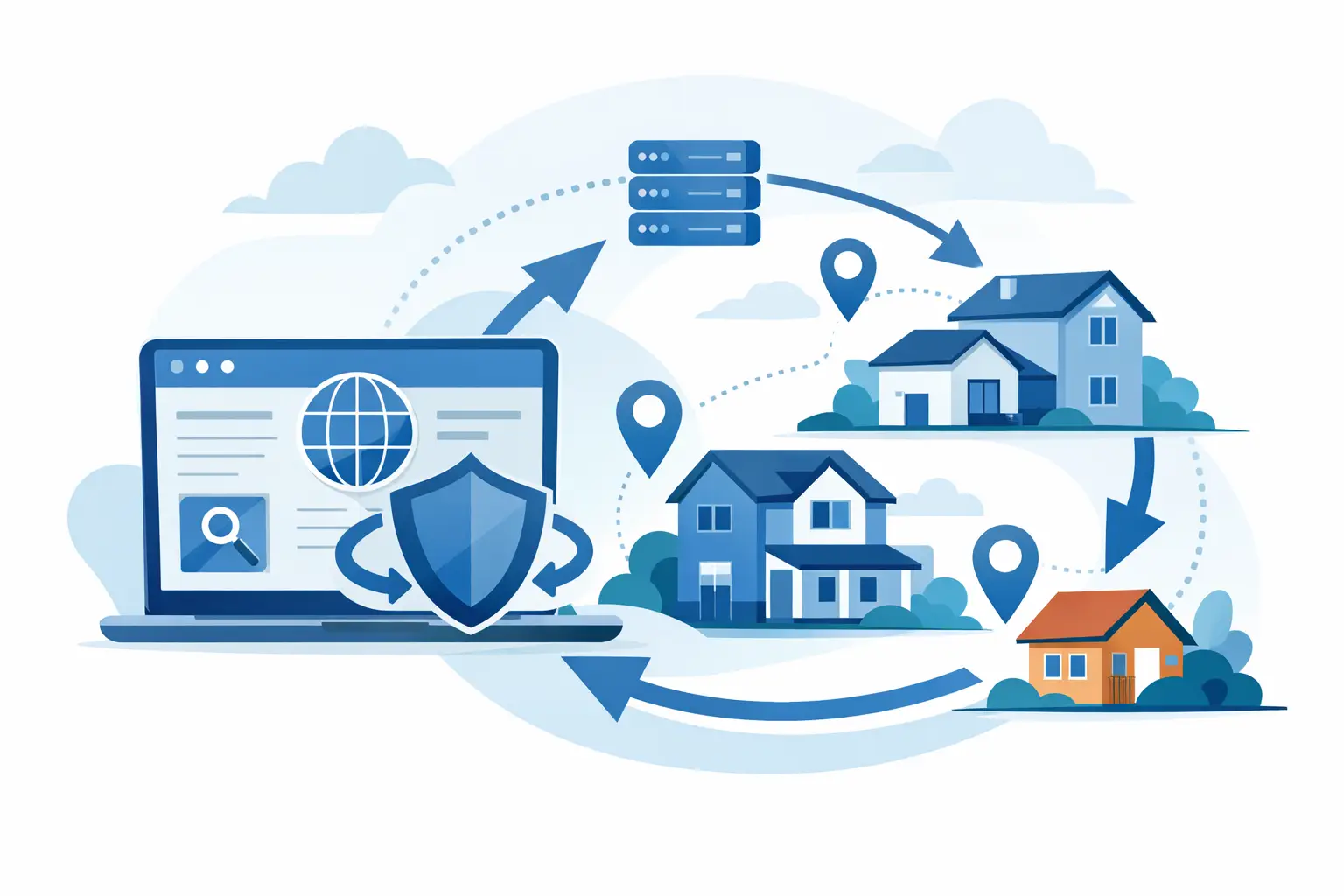
A rotating residential proxy routes your traffic through real IP addresses that internet service providers assigned to actual households, and automatically switches which address is used either on every request or at a set interval. Instead of hammering a target from one endpoint, your requests spread across a broad pool of home-user IPs, so the activity pattern resembles organic consumer browsing rather than a concentrated automated source.
That matters the moment a job stops working. When a scrape starts throwing 403 errors after the third page, or ad verification checks keep landing on the wrong regional content, the question shifts from "do I need proxies?" to "what kind, and why?" Rotation is usually the answer to the first failure, and the rest of this guide covers when it is not.
For teams running scraping pipelines, verifying ads, tracking search results or managing accounts at scale, the distinction is practical rather than cosmetic. The traffic is legitimate at the network level because it genuinely originates from residential connections, not server farms.

Rotating Residential vs. Datacenter Proxies
The core difference comes down to where the IP originates. Residential proxies carry addresses assigned by ISPs to real homes, so target sites treat the incoming traffic more like a normal user. Datacenter proxies pull from cloud provider IP ranges, which many anti-bot systems have catalogued and can filter aggressively.
Sites can and do blacklist entire datacenter IP ranges in bulk. A residential IP from a home connection in Austin or Chicago is far harder to discard without also blocking genuine users. That network-level credibility is exactly what makes residential proxies worth the premium for detection-sensitive workloads.
Datacenter proxies are not inferior across the board. They are faster, often significantly cheaper, and perfectly capable for targets that do not employ strict filtering. The distinction is that residential rotation gives you a stronger disguise when blending in with real users is the actual requirement, not just a nice-to-have.

What is rotating residential proxies and how do they work?
At the basic level, a proxy server sits between your software and the target website. The site sees the proxy IP, not your originating address. Understanding how rotating residential proxies work involves looking at how requests are routed through a massive network of home devices. Infrastructure from Bright Data provides a massive network of real-user IPs that facilitates this rotation seamlessly.
With residential proxies, the visible IP belongs to an ISP and maps to a household connection. This provides far more credibility than a server-farm address. The core mechanism is ip rotation, which ensures your identity is constantly masked by new addresses.
Rotation controls which residential IP gets used at any given moment. Depending on your provider and configuration, that swap can happen in three primary ways:
-
Per-request rotation: Every HTTP call goes out through a different IP from the pool. Best for large-scale scraping where you want maximum distribution and no repeated patterns.
-
Time-based rotation: The IP changes on a set schedule, such as every 1, 5, or 10 minutes. Useful when you need some continuity within a window but still want regular refreshes.
-
Session-based rotation: The IP holds stable for the duration of a session, then rotates when that session ends. This is the basis for sticky sessions in login-heavy or multi-step workflows.

Your requests go through a gateway endpoint that handles the actual IP assignment and switching behind the scenes. You send traffic to one consistent connection string; the residential IP network does the rest.
The quality of the underlying residential IP network shapes everything. A small pool means rotation repeats IPs quickly, which undermines the whole point. Thin geographic coverage limits geo-targeting. Weak session controls make login-based tasks unstable. Proxy rotation is only as effective as the infrastructure running beneath it.
Types of Rotating Proxies
Three main categories exist, each with a distinct IP source and trade-off profile.
Rotating residential proxies draw from ISP-assigned home addresses. Traffic blends with genuine user patterns, which makes detection much harder. These are the go-to for high-volume extraction from detection-aware targets because of high ip quality.
Rotating datacenter proxies use IPs from cloud providers. They are faster and more affordable but identifiable, since their IP ranges are publicly known. Many platforms maintain blocklists for common datacenter subnets. Strong for speed and cost efficiency on lower-friction targets.
Rotating mobile proxies route through actual smartphones and tablets on carrier networks. Mobile IPs are genuinely difficult for sites to block because doing so would cut off real paying customers. The trade-off is cost and occasionally variable speed depending on whether the device is on cellular data. For most production scraping or ad verification work, rotating residential proxies hit the right balance. Mobile proxies shine in edge cases where everything else has already been flagged.

Why rotating residential proxies are different from static proxies
The clearest way to frame the difference is persistence versus distribution. A static proxy gives you one fixed IP that stays the same across all requests, offering consistency and a stable identity. A rotating residential proxy spreads traffic across many different IPs, prioritizing volume tolerance and evasion over continuity.
Static residential proxies and sticky proxies are useful when your workflow depends on a consistent identity. ISP proxies fall into a similar category, offering residential-looking addresses that stay fixed, which suits allowlisting or platforms that flag sudden IP changes mid-session.
Rotating proxies serve the opposite need. When the challenge is request volume, anti-bot filtering, or geo-access across multiple markets, distributing traffic through a rotating pool is the more effective approach.
Session continuity matters for certain task types. Login flows, cart actions, and multi-step actions that span several pages all require the same IP throughout. Sticky sessions address this by holding one residential address stable for a defined window before rotating. Without sticky session support, rotation can break these workflows entirely.

Static vs. Rotating: When to Use Each
Static proxies are the right call when your workflow requires a trusted, unchanging identity. Managing a social media account, running login-based automations, and testing web applications that track session state all benefit from IP stability. Switching addresses mid-task can trigger security alerts or break authentication flows.
Rotating proxies are designed for high-volume, distributed data work. Per-request rotation makes it structurally difficult for sites to tie a pattern to a single source. That extra layer of distribution reduces block rates on targets with aggressive rate limiting or fingerprinting.

Choosing the Right Tool for the Job
If your work involves repeated high-frequency requests, pulling product data, monitoring prices, or collecting localized search results, rotating residential proxies are generally the better fit.
If you are handling account-based tasks or working against targets that do not actively filter, static proxies at a lower cost often get the job done without overcomplicating the setup.
Match the proxy type to the actual workload demands rather than defaulting to the most capable option. The most expensive setup is not always the most effective one for your specific situation.
Alternatives and When Rotation Is Not Necessary
Not every use case needs full rotating residential proxy infrastructure. If you require a consistent IP for account management, web app testing, or scraping low-friction targets, a sticky session with a static proxy is often sufficient and meaningfully cheaper.
A proxy rotator used as an add-on can extend a static proxy setup by cycling through a pool of fixed addresses, giving you some distribution benefit without committing to a full residential rotation service. That combination adds cost and complexity, so it makes more sense for workflows that genuinely need flexible coverage.
VPNs are another option worth understanding. They encrypt your traffic and mask your IP, which serves personal privacy well. Most VPN services use server-based IPs rather than residential ones, and IP changes require manual server switches rather than automatic per-request rotation. For high-frequency automated tasks, VPNs introduce latency overhead and lack the granular control that proxy rotation provides. They are better suited to individual browsing privacy than production automation.
Where rotating residential proxies make the biggest impact
Web scraping and high-volume extraction see the clearest benefit. Pulling product listings, pricing, reviews, job posts, or public business records from a single IP invites rapid rate limiting or outright bans. Rotating through residential IPs distributes the request load so collection jobs run longer with fewer interruptions.
Ad verification depends heavily on both identity and location. Checking what users in a specific city or country actually see requires traffic that looks like it genuinely originates there. Residential IPs improve the credibility of those checks. Rotating across placements helps when you are validating campaigns across multiple publishers in sequence.
Price monitoring and market intelligence benefit from rotation when competitive data spans multiple markets or when target sites throttle repeated queries from the same source. Distributing requests across a broad residential IP pool lets you collect pricing data across regions without triggering defenses.
SEO research and SERP monitoring are particularly sensitive to IP-based filtering. Search engines localize results and respond to automated query patterns. A large residential IP pool lets you gather location-specific search data with fewer interruptions and cleaner results. Over-rotation on search queries can sometimes look unnatural too, so matching rotation cadence to query volume matters.
Account operations require more nuance. Rotation helps when managing access at scale, but login-heavy workflows need controlled rotation rather than constant switching. Sticky sessions are the practical answer here, holding one IP stable through a complete session before cycling.
For personal use cases, rotating residential proxies also help with privacy-conscious browsing, side-project scraping, and accessing geo-restricted content. That said, proxies mask your IP but do not solve browser fingerprinting or cookie tracking on their own. They are one layer in a broader operational security approach.
The main benefits
Lower block rates. When traffic rotates through a large pool of residential IPs, no single address accumulates enough request density to trigger anti-bot systems. Target sites see what appears to be distributed consumer traffic rather than a concentrated automated source. This does not make detection impossible, but it raises the threshold considerably.
Geo-targeting precision. Strong residential networks provide coverage across countries, states, and in some cases cities. City-level targeting matters for pricing intelligence, localized SERP collection, and ad verification where a campaign only serves specific regions. Datacenter proxies often cannot offer the same geo precision because their IPs cluster in hosting facilities rather than consumer locations. Companies such as Oxylabs offer extensive city-level targeting that allows for hyper-local data collection.
Better success rates at scale. Distributing requests across a large proxy pool keeps throughput stable as job volume grows. A large, well-maintained pool means IP reuse stays low and IP reputation stays cleaner. This directly impacts overall proxy performance during heavy tasks.

Your success rate holds up over longer collection windows when using high-tier providers. A shallow pool defeats the purpose of rotation because the same addresses reappear quickly. Consistent ip rotation is necessary to keep detection rates low.
Operational flexibility. You can pair rotating residential proxies with scrapers, browsers, automation frameworks, and custom scripts without major architectural changes. Per-request rotation suits broad collection tasks. Sticky sessions handle captcha-adjacent workflows, carts, and sign-in sequences that need continuity.
Captcha reduction. Rotating through fresh residential IPs with clean reputation scores reduces how often target sites serve captcha challenges. Sites trigger captchas when they detect suspicious patterns, and distributing requests across legitimate-looking residential IPs disrupts those pattern signals. It is not a complete captcha-elimination strategy, but the reduction in rate limit encounters and detection flags is measurable in practice.
The trade-offs you should know before buying
Cost is the first real consideration. Residential proxies are typically billed by bandwidth and priced above datacenter options. Proxy pricing reflects the higher cost of sourcing and maintaining legitimate residential IP access. If your targets are low-friction and do not require residential legitimacy, paying for it delivers little incremental value. Cost per success matters more than cost per gigabyte in isolation. While pricing varies, providers like IPRoyal offer models that can be more accessible for smaller teams.
Speed can be less predictable than with datacenter proxies. Residential routes depend on a peer-based network of actual household connections, and those vary in quality. Latency-sensitive tasks, especially real-time checks or tight timing requirements, may experience more variability than a high-performance datacenter setup would.
Over-rotation risk is something fewer buyers think about upfront. Switching IPs too aggressively on tasks that require continuity, like multi-step login flows or cart sessions, can break workflows or trigger security reviews. The right rotation cadence depends on the target site behavior and the task type, not just maximum churn.
Concurrency and session controls vary significantly by provider. Some offer fine-grained country and city targeting, custom rotation intervals, and sticky session length controls. Others are more basic. If your workflows require precise configuration, confirm those options are actually available before you commit.
Compliance should be part of the technical evaluation. How the proxy provider sources its IPs, what their usage policies say, and whether your activities respect site terms and applicable law are not afterthoughts. Serious operators treat provider sourcing transparency as a requirement, not a bonus feature. Verifying the sourcing practices of a provider like Decodo is a key step in ensuring long-term project stability.

Rotating Datacenter Proxies: A Quick Comparison
Rotating datacenter proxies use IP addresses from large cloud providers like AWS, Google Cloud, or similar infrastructure. Because these IPs are not associated with any ISP or household, they are identifiable as datacenter traffic. Many sites maintain lists of known datacenter IP ranges and apply stricter filtering to traffic from those blocks.
The upside is performance and cost. Datacenter IPs run on high-bandwidth infrastructure, which keeps speeds fast and latency low. Buying datacenter IPs in volume is far cheaper than equivalent residential bandwidth. For high-volume tasks on targets that do not aggressively filter by IP origin, rotating datacenter proxies are a sensible choice.
The limit is stealth. On sites that specifically block datacenter ranges or check IP origin as part of their bot detection stack, datacenter proxies will hit walls that residential rotation bypasses. Knowing which your target uses is the key decision factor.

How to tell if you need rotating residential proxies
If your collection jobs are consistently running into captcha challenges, 403 errors, or immediate rate limits even at modest request volumes, you are likely hitting detection based on IP reputation or traffic concentration. Distributing requests through residential rotation is the most direct fix.
If your data changes by geography and you cannot validate it from your current connection, you need geo-targeted residential access. Seeing the same result from a shared datacenter IP does not tell you what a user in a specific city actually sees.
If your current setup works at low volume but degrades as you scale, rotation is likely the missing piece. A single IP or a small static pool cannot absorb increasing request loads without accumulating detection signals.
Captcha solving tools can help as a layer, but they address a symptom rather than the source. Reducing captcha encounters through better IP distribution and residential legitimacy is a more durable approach than trying to solve challenges after they appear.
On the other hand, if your targets are easy to access and do not apply strict filtering, rotating datacenter proxies may handle the workload at lower cost. If you need a fixed identity for an application allowlist or account-stable environment, static proxies are the better fit. The most effective proxy decision comes from matching the tool to the actual friction your workflows encounter.

Alternatives and Add-ons Worth Considering
Proxy rotators offer a middle path for teams using primarily static proxies. A rotator tool automatically cycles through your available static addresses, giving you some distribution benefit without requiring a full residential subscription. Useful for workflows that need occasional rotation but do not justify the ongoing cost of a large residential pool.
VPNs encrypt traffic and mask your IP at the device level. They work well for individual privacy and accessing region-restricted content personally. For automated, high-frequency tasks, they introduce latency and lack the per-request IP switching that serious automation requires. Some VPN providers offer scheduled IP changes, but these are too coarse for production scraping or verification workloads.
Sticky sessions without rotation are sometimes the right answer entirely. If you are managing accounts, testing authenticated flows, or working against targets that do not apply aggressive bot filtering, holding one clean IP stable throughout the task avoids unnecessary complexity.
There is no single correct proxy configuration for every workflow. Evaluate the specific friction points in your tasks, the sensitivity of your targets, and your cost constraints, then choose the simplest setup that reliably solves the problem.

What to look for in a provider
Pool size is foundational. A larger network of residential IPs means rotation stays genuinely diverse, repeat-address frequency stays low, and distribution holds up under heavy request loads. IP pool size differences between providers directly affect how quickly your traffic pattern becomes recognizable.
Geographic coverage determines whether your geo-targeting ambitions are actually achievable. Providers with broad country and city-level coverage give you more reliable localized data. Thin coverage means geo-targeting becomes approximate rather than precise.
Session controls matter for task flexibility. You need both per-request rotation for broad scraping and sticky session options for login-based and multi-step workflows. A provider that only offers one mode forces you to compromise on one category of tasks.
Compliance and sourcing transparency are meaningful evaluation criteria, not just legal boilerplate. When looking for the best rotating residential proxies, sourcing is key. Leading companies prioritize ethical acquisition to maintain network integrity.
Established providers like Bright Data, Smartproxy, Oxylabs, IPRoyal, SOAX, Webshare, NodeMaven, NetNut, and Decodo maintain documented sourcing practices. Understanding how IPs are acquired reflects on the reliability and ethical standing of the network you are using.

Uptime and support quality affect operational continuity. A proxy outage during a time-sensitive collection run costs more than the proxy subscription itself. Providers built for production workloads offer responsive support, real-time dashboards, and infrastructure designed to stay stable under load.
When comparing residential proxy providers, the label alone is not enough. Ask about actual IP pool size, country and city availability, rotation configuration options, and what the onboarding and support experience looks like in practice. The best residential proxy providers offer trial access or entry-level plans so you can validate performance before committing at scale.
Beware Free Proxy Lists
Free proxy lists are appealing when you are trying to move quickly, but the practical risks outweigh the cost savings for almost any real workload. Free proxies are shared among many unknown users, which accelerates blocklisting and degrades the IP reputation of every address on the list.
Sourcing is a genuine concern. Many IPs on public lists were obtained without the owner's consent, making them part of compromised device networks or outright botnets. Using them exposes you to potential legal gray areas and security risks including malware injection and credential interception.
Anti-bot systems specifically target public proxy lists. Addresses from free lists often appear in detection databases within hours of becoming public. For scraping or automation, these IPs represent the path of maximum resistance rather than a shortcut.
The business model behind free proxies rarely involves genuine generosity. If no payment is involved, the provider is monetizing the service through other means, typically by tracking your activity, injecting ads, or using your connection as a relay for other traffic.

Why Reputable Providers Matter
Paid residential proxy providers invest in sourcing infrastructure, legal compliance, and network maintenance that free lists simply cannot offer. The difference shows up in success rates, uptime, geographic coverage accuracy, and the degree of control you have over rotation and session behavior.
Evaluating providers critically before committing matters. Look for documented pool sizes, transparent sourcing and consent practices, flexible rotation controls, and accessible support. The best providers let you test with a limited plan before scaling up, so you can verify that performance matches what the product page claims.
For any workload involving sensitive data, compliance requirements, or revenue-generating automation, professional-grade residential proxy infrastructure is the responsible baseline, not an upgrade.

How do VPNs compare to rotating proxies for hiding your IP address?
Both tools mask your real IP by routing your connection through another server, but the mechanics and appropriate use cases differ substantially.
A VPN like NordVPN or ExpressVPN is built for personal privacy. It encrypts your entire device's traffic through a tunnel, assigning you an IP from the VPN provider's own pool. The IP typically stays fixed until you manually choose a different server. Some providers offer scheduled IP changes, but rotation is slow and tied to server selection rather than request-level switching. VPN IPs are also generally server-based rather than residential, which means sites can still identify them as non-consumer traffic.
Rotating residential proxies are purpose-built for automated, high-frequency tasks. Each request can exit through a different legitimate household IP, distributing your activity across a wide geographic and network footprint. There is no manual switching required, and the rotation happens transparently at the infrastructure level.
The practical split is straightforward. VPNs handle personal browsing privacy and occasional geo-access needs well. They add encryption overhead that slows high-volume automation and lack the per-request IP switching that scraping, ad verification, or market intelligence work requires. Rotating residential proxies handle those demanding tasks but do not provide the device-level encryption that VPNs offer. For most production automation, the speed and IP flexibility of rotating proxies matters more than the encrypted tunnel.

What is a proxy rotator and how does it work as an add-on?
A proxy rotator is a software layer that automatically cycles through a list of IP addresses, directing each outgoing request through a different address from your available pool. Think of it as a traffic manager sitting in front of your existing proxies, deciding which address handles each connection.
As an add-on to a static proxy setup, a rotator expands your distribution without requiring you to migrate to a full rotating residential service. You feed it your collection of static IPs, configure a rotation schedule (per request, per session, or timed), and the rotator handles address assignment automatically. This reduces repetitive traffic patterns from any single IP and lowers the risk of triggering rate limits.
Many full rotating residential proxy services include a backconnect gateway as part of their architecture. A backconnect gateway is a single endpoint address that you connect to once; the service assigns outbound IPs dynamically from the residential pool on your behalf. This is architecturally similar to a rotator, but managed entirely by the provider rather than assembled from a static list.
A proxy manager takes this further by adding dashboard controls, usage analytics, geo-targeting rules, session length configuration, and authentication management. For teams running multiple concurrent workflows with different rotation requirements, a proxy manager centralizes control and reduces operational overhead.
As a standalone add-on, a proxy rotator is a practical middle ground for workflows that need some distribution benefit but do not justify the cost of a full residential rotation subscription. For higher-volume or detection-sensitive tasks, the purpose-built rotating residential infrastructure from a reputable provider will outperform a DIY rotator built on static IPs.
How do you set up and use rotating proxies?
Getting started with a rotating residential proxy setup is straightforward once you have chosen a reputable provider. The provider gives you a gateway endpoint address, a port number, and credentials (username and password). You plug those into your tool, script, or browser configuration, and the rotation runs automatically on the provider's side.
Before getting to code, resist the temptation to grab free proxy lists. They introduce malware risk, unreliable uptime, and near-instant blocklisting. The time saved by avoiding a paid subscription gets spent diagnosing failures and working around bans. Session control, geo-targeting, and rotation scheduling are features that only legitimate providers offer reliably.
Here are integration examples for common environments:
cURL:
curl --proxy "http://username:password@proxyhost:port/" https://example.com/Python (requests library):
import requests

proxies = {
    "http": "http://username:password@proxyhost:port/",
    "https": "http://username:password@proxyhost:port/"
}
response = requests.get("https://example.com/", proxies=proxies)
print(response.text)
Node.js (request module):
const request = require('request');

request({
    url: 'https://example.com/',
    proxy: 'http://username:password@proxyhost:port/'
}, function(err, res, body) {
    console.log(body);
});
Java (Apache HttpClient):
import org.apache.http.HttpHost;
import org.apache.http.client.fluent.*;

public class Example {
    public static void main(String[] args) throws Exception {
        HttpHost proxy = new HttpHost("proxyhost", port);
        String res = Executor.newInstance()
            .auth(proxy, "username", "password")
            .execute(Request.Get("https://example.com/").viaProxy(proxy))
            .returnContent().asString();
        System.out.println(res);
    }
}
Most rotating residential providers expose a single gateway endpoint. You do not manage a list of IPs manually. You connect to the gateway, and the backend assigns a different residential IP for each request or session automatically.
Avoiding Free Proxy Pitfalls
Public proxy lists are heavily abused by other users, making the IPs among the most recognized and blocked addresses on any modern anti-bot stack. Security risks compound the performance issues. Some free endpoints log and resell your traffic. Others are actively compromised. For any real workload, the risk-to-benefit ratio does not justify the cost savings.

Recommended Setup Steps
-
Register with a provider that has transparent policies, documented pool sizes, and clear session control options.
-
Choose your rotation policy based on your task type: per-request for broad scraping, sticky sessions for login or multi-step workflows.
-
Integrate using the code pattern that matches your language and framework, substituting your actual credentials and endpoint.
-
Validate with a small test run before scaling. Check that IPs are changing as expected, geo-targeting returns correct locations, and session behavior matches your configuration.
-
Use the provider dashboard to monitor usage, check bandwidth consumption, and troubleshoot any connection or targeting issues before they affect larger jobs.
Once your setup is verified, you can focus on the actual work rather than proxy management.
How do rotating datacenter proxies work?
Rotating datacenter proxies use IP addresses provisioned by cloud infrastructure providers rather than residential ISPs. The IPs come from server farms running on platforms like Amazon Web Services, Google Cloud, or DigitalOcean. Because these are server-based addresses and not tied to any household, they are identifiable as datacenter traffic by anyone who checks the IP origin.
Rotation works the same way as with residential proxies: per request, on a time interval, or at session end. Each outbound connection gets assigned a different datacenter IP from the provider's pool. The gateway handles assignment automatically.
Datacenter IPs carry two meaningful advantages. First, they are fast. High-bandwidth server infrastructure keeps latency low and throughput high. Second, they are affordable. Acquiring datacenter IPs in bulk is far cheaper than sourcing residential addresses, which translates to lower pricing for the end user.
The limitation is visibility. Datacenter IPs do not match normal consumer traffic patterns, and their address ranges are publicly documented. Anti-bot systems, including common CDN-level protection layers, often maintain blocklists of known datacenter subnets. A request from a flagged datacenter range may be blocked before it reaches the application.
For targets that apply strict IP origin checks or specifically filter non-residential traffic, rotating datacenter proxies will hit blocklists that residential rotation bypasses. For targets that do not apply that level of scrutiny, datacenter proxies deliver better speed at lower cost. Matching the proxy type to the target's actual filtering behavior is the deciding factor.

How to configure rotating proxies in different programming languages
Configuration follows the same pattern across languages: provide the proxy endpoint, port, and credentials. The rotating IP assignment happens on the provider's infrastructure, so your code stays simple.
cURL:
curl --proxy "http://USERNAME:PASSWORD@ROTATING-PROXY-ENDPOINT:PORT/" https://example.com/Python (requests):
import requests

proxies = {
    "http": "http://USERNAME:PASSWORD@ROTATING-PROXY-ENDPOINT:PORT/",
    "https": "http://USERNAME:PASSWORD@ROTATING-PROXY-ENDPOINT:PORT/"
}
response = requests.get("https://example.com/", proxies=proxies)
print(response.text)
Node.js:
const request = require('request');

request({
    url: 'https://example.com/',
    proxy: 'http://USERNAME:PASSWORD@ROTATING-PROXY-ENDPOINT:PORT/'
}, function(err, res, body) {
    console.log(body);
});
Java (Apache HttpClient):
import org.apache.http.HttpHost;
import org.apache.http.client.fluent.*;

public class Example {
    public static void main(String[] args) throws Exception {
        HttpHost proxy = new HttpHost("ROTATING-PROXY-ENDPOINT", PORT);
        String res = Executor.newInstance()
            .auth(proxy, "USERNAME", "PASSWORD")
            .execute(Request.Get("https://example.com/").viaProxy(proxy))
            .returnContent().asString();
        System.out.println(res);
    }
}
PHP, Ruby, C#, and Go all follow the same credential-injection pattern. The endpoint address stays constant in your code; the provider's backend handles IP selection and rotation transparently.
Most providers include a dashboard with language-specific code snippets pre-populated with your credentials. That removes the risk of formatting errors and speeds up the integration step considerably.
The unique role of rotating mobile proxies
Rotating mobile proxies occupy a specific niche that residential and datacenter proxies do not fill equally well. Instead of routing through household connections, mobile proxies use actual smartphones and tablets operating on carrier networks from providers like AT&T, Verizon, Vodafone, or T-Mobile.
The primary advantage is trust level. Carrier-assigned mobile IPs are used by millions of real subscribers. Sites are structurally reluctant to block mobile IP ranges because doing so cuts off legitimate paying customers. That hesitancy translates to industry-leading anonymity and success rates in environments where other proxy types have already been flagged.
Mobile IPs are also naturally dynamic. Carriers reassign addresses frequently, and multiple users often share a single IP through carrier-grade NAT. This makes pattern detection by target sites significantly harder. Flagging one mobile IP risks affecting real users, so thresholds for action are higher.

The trade-offs are cost and speed. Mobile proxies command a premium over both residential and datacenter options, reflecting the genuine complexity of sourcing real mobile bandwidth. Performance can vary more than wired connections, particularly when source devices are on cellular data rather than Wi-Fi.
For most scraping, ad verification, or account management workflows, rotating residential proxies hit the right balance between stealth, speed, and cost. Mobile proxies make sense as an escalation layer when residential rotation has already encountered consistent blocking, or when the target specifically filters out non-mobile traffic. Think sneaker release sites, ticketing platforms, or services that apply extreme location-based throttling. In those edge cases, mobile rotation offers coverage that nothing else matches. For everyday data workflows, the cost premium rarely justifies the marginal stealth increase.
How do rotating mobile proxies work?
Mobile proxies route your requests through real devices on cellular networks rather than through wired residential connections or data centers. When you send a request through a rotating mobile proxy, the provider assigns your traffic to a device with an active carrier-issued IP. With per-request rotation, the next request may go through a completely different device in a different city or country.
Carriers use dynamic IP assignment and carrier-grade NAT, meaning multiple legitimate subscribers share and cycle through the same address ranges. Websites see a stream of requests from addresses that genuinely belong to real mobile users, with no reliable way to distinguish your automated traffic from someone browsing on 4G during their commute.
This is why mobile proxies are considered the hardest to detect and block. Anti-bot systems that confidently block server IPs or even flag residential ranges are much more cautious with mobile traffic, where false positives mean alienating real customers.

The operational cost reflects the underlying complexity. Real mobile bandwidth is more expensive to source and less elastic than datacenter or even residential infrastructure. Connection speeds depend partly on the quality and network conditions of the device in use, which introduces variability that wired connections avoid.
For the majority of scraping, ad verification, and market intelligence work, rotating residential proxies provide the right trade-off between cost, speed, and detection resistance. Mobile proxies are the right escalation when residential rotation has reached its limit, particularly for targets with aggressive mobile-specific defenses or region-based throttling that specifically targets non-mobile traffic.
The risks of using free proxy lists
Free proxy lists carry risks that tend to surface quickly once you actually use them in production. The most immediate is trust. There is no verifiable way to know how those addresses were sourced or what the operators are running on the backend. Some free proxies are compromised devices enrolled in botnets without the owner's knowledge. Using them puts you in proximity to that activity, which creates both security exposure and potential legal complications.
Performance on free lists degrades fast. Public endpoints attract high user volumes, and shared bandwidth across many simultaneous connections produces slow, inconsistent throughput. Even if a connection succeeds, anti-bot systems have usually catalogued these addresses. Your requests hit detection filters before they accomplish anything useful.
The security surface is meaningful. Free proxies can intercept unencrypted traffic, inject ads or malicious content, and harvest credentials from sessions that pass through them. If the proxy is not charging you, it is generating value elsewhere, and your data or activity is a likely candidate.
None of this means paid proxies are risk-free, but the risk calculus is different. Reputable providers have business incentives to protect your data, maintain network quality, and operate within legal frameworks. The transparency of their sourcing, policies, and technical controls gives you something to evaluate. Free proxy lists offer none of that, and the consequences of a compromised session or a blocklisted IP range falling on your account can cost far more than a subscription would have.
What are rotating mobile proxies?
Rotating mobile proxies are proxy services that route your traffic through real mobile devices on carrier networks, automatically switching between device IPs with each request or at defined intervals. The IPs originate from phones and tablets using cellular data plans, not from wired household connections or server infrastructure.
The defining characteristic is the trust level that carrier IPs carry with online platforms. Because mobile addresses are shared across large subscriber populations and reassigned dynamically, they are treated as highly legitimate traffic sources. Platforms are reluctant to block them broadly, and their natural IP dynamics make pattern detection harder.
This makes rotating mobile proxies particularly effective for tasks that require the highest degree of anonymity or for targets that have specifically blocked residential and datacenter IP ranges. Ad verification on mobile-specific placements, testing geo-restricted mobile content, and bypassing extreme anti-bot defenses are use cases where the mobile origin of the IP matters.
The premium cost and variable connection speeds are the primary trade-offs. Mobile bandwidth is genuinely more expensive to source, and cellular data conditions introduce more variability than wired connections. For most scraping, monitoring, or data collection workflows that are well served by residential rotation, the additional cost of mobile proxies delivers diminishing returns. They are most valuable as a targeted tool for edge cases where residential coverage has run out, not as a default choice for all automation work.
Frequently asked questions
- What is a rotating residential proxy?
- A rotating residential proxy routes your traffic through real IP addresses that internet service providers assigned to actual households, and automatically changes which address is used either on every request or at a set time interval. Because the exit IPs belong to genuine residential connections rather than servers, the traffic pattern resembles ordinary consumer browsing.
- How do rotating proxies work?
- You connect to a single gateway endpoint instead of to individual IPs. The provider assigns an exit IP from its pool for each request or session, then swaps it according to your rotation setting. Your tooling only ever sees one host and port, so the rotation happens on the provider side and needs no change to your scraper or automation.
- When should you use rotating proxies instead of static ones?
- Use rotating IPs for high-volume, stateless work where each request is independent: scraping listings, collecting search results, checking prices or verifying ads across many locations. Use static or sticky IPs when the target tracks a session — logins, carts, multi-step forms and account management — because changing address mid-session is itself a signal.
- What rotation interval should I use?
- Per-request rotation suits bulk collection where no state carries between requests. Sticky sessions lasting a few minutes suit sequences that must complete from one identity. Over-rotating is a real failure mode: switching IP in the middle of a multi-step flow can break the session and produce noisy data that looks like target-side blocking.
- Are rotating residential proxies legal?
- Using residential proxies is legal in most jurisdictions, but legality depends on what you do with them and how the provider sourced its IPs. Collecting publicly accessible data is treated differently from bypassing authentication or violating a contract you agreed to. Check the provider consents properly for its pool, and review the terms of any site you automate against.