Guide
Why Do Scrapers Use Proxies?
Why do scrapers use proxies? Learn how proxies reduce blocks, spread requests, enable geo-targeting, and improve data collection at scale.
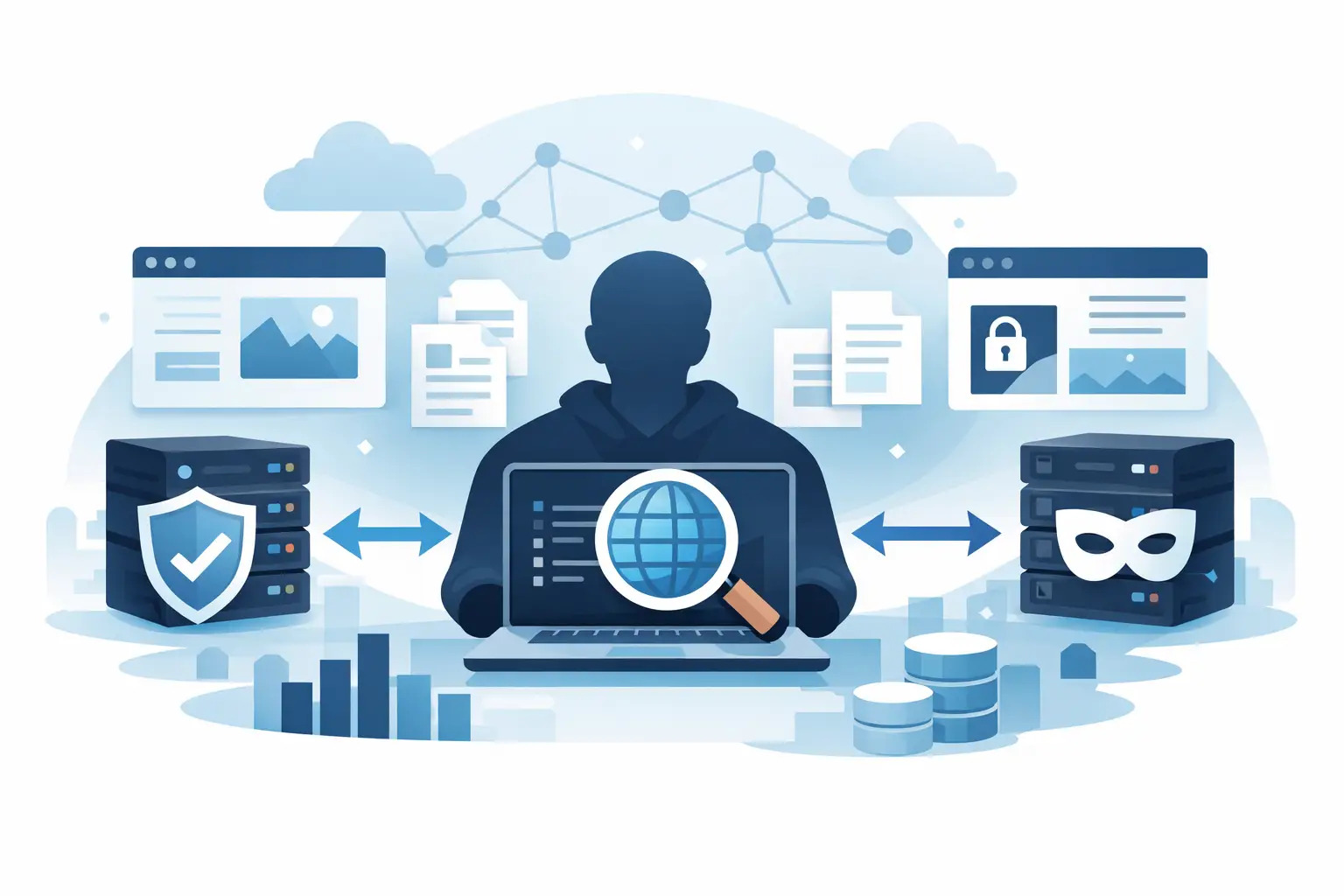
A scraper that sends thousands of requests from one IP does not look like a normal user. It looks like automation, and most target sites are built to detect exactly that. That is the core answer to why do scrapers use proxies: proxies give operators more IPs, better distribution, location control, and a much higher chance of collecting data without constant blocks.
At small volume, you can sometimes get away with direct requests. At any meaningful scale, that breaks fast. Rate limits hit, CAPTCHA pages appear, sessions get flagged, and your data pipeline turns into a cleanup job instead of a collection system.
Why do scrapers use proxies at all?
Proxies sit between the scraper and the target website. Instead of every request coming from the same machine and IP, requests can be routed through different IP addresses, networks, and locations. That changes how the target sees your traffic.
For scraping, that matters because websites judge traffic patterns at the IP level first. If one IP requests 500 product pages in a few minutes, the site may throttle, block, or challenge that IP. If those requests are distributed across a larger proxy pool with better pacing, the traffic looks less concentrated and is harder to shut down with a single rule.
This is not just about hiding an IP. It is about maintaining access long enough to complete jobs reliably. A scraper that works for 15 minutes before getting blocked is not useful in production. Operators use proxies because uptime and completion rate matter more than theoretical request volume.
Proxies reduce blocks and rate limits
The most obvious reason scrapers use proxies is block avoidance. Most websites apply request thresholds per IP, per session, or per subnet. Once your traffic crosses those thresholds, your access degrades.
With proxies, request volume can be spread across many addresses. That lowers pressure on each individual IP. Instead of hammering a target from one origin, the scraper rotates through a pool, which makes the traffic profile more manageable.
There is still a trade-off. Rotation alone does not fix bad scraper behavior. If headers are inconsistent, concurrency is too high, or browser fingerprints look fake, a site can still detect the operation. Proxies improve survivability, but they work best when paired with sane request logic and session handling.
They let scrapers scale without collapsing their own infrastructure
Scaling a scraper is not just a code problem. It is an access problem. You can build a fast crawler, parallelize requests, and optimize parsing, but if all traffic comes from a single connection path, the target will become the bottleneck.
Proxies give operators a larger surface area for outbound traffic. That allows more workers, more sessions, and more retries without concentrating everything on one IP. For teams collecting pricing data, search results, marketplace listings, ad placements, or public business records, that difference is operational, not theoretical.
A direct connection might support testing. A proxy-backed setup supports recurring collection jobs, multi-market monitoring, and time-sensitive data pulls where failure costs more than bandwidth.
Why do scrapers use proxies for geo-targeting?
Many websites do not show the same content to every visitor. Search engine result pages, local inventory, pricing, ads, travel listings, and marketplace offers can all change based on country, city, or carrier. If you scrape from the wrong location, you may collect the wrong data.
Proxies solve that by giving the scraper IPs in specific regions. A US retail analyst may need product availability in California, Texas, and New York. An ad verification team may need to confirm what users in Germany or Brazil actually see. An SEO operator may need localized SERP data rather than generic results from a single data center.
Without location-specific proxies, you are often measuring your own network view, not the market reality. For businesses making pricing, media buying, or competitive decisions, that is a serious accuracy problem.
They help preserve session continuity when needed
Not every scraping task should rotate on every request. Some targets work better when a session stays on the same IP for a period of time. That is common with login-based flows, carts, paginated searches, and account-level interactions.
Proxies make it possible to choose between sticky sessions and aggressive rotation depending on the target. That flexibility matters. Too much rotation can look unnatural in session-heavy environments. Too little rotation can burn an IP quickly on high-volume targets.
Good operators match proxy behavior to the website. Residential proxies are often useful when the target is sensitive to traffic origin quality. Datacenter proxies can be a better fit when speed and cost per gigabyte matter more and the target is less aggressive.
Different proxy types solve different scraping problems
When people ask why scrapers use proxies, the real answer often depends on what they are scraping.
Residential proxies route traffic through consumer IPs. They are generally better for sites that score IP reputation aggressively because the traffic appears closer to normal user traffic. That usually improves access on difficult targets, though bandwidth costs are higher.
Datacenter proxies come from hosted server environments. They are usually faster, cheaper, and easier to deploy at volume. They work well for lower-friction targets, high-throughput collection, and workflows where cost efficiency matters more than stealth.
Mobile proxies exist too, though they are usually a narrower tool for specific use cases. The point is simple: proxy choice changes both economics and success rate. A cheap proxy pool that gets blocked instantly is not actually cheap. A premium pool on an easy target may be overkill.
Proxies support testing, retries, and recovery
Production scraping is messy. Requests fail. Targets change layouts. Some endpoints slow down. Others trigger anti-bot checks at random intervals. Proxies help absorb that mess.
If one IP gets challenged, another can continue the job. If one region returns incomplete content, traffic can be rerouted. If a subnet is burned, operators can swap pools without rewriting the scraping system. That kind of redundancy is why serious scraping stacks treat proxy access as infrastructure, not a nice-to-have add-on.
This is also where provider quality matters. Large IP pools, wide country coverage, stable routing, and fast provisioning reduce downtime when conditions change. For teams that need immediate scale, a provider such as FlameProxies fits that requirement by offering broad coverage, usage-based access, and quick deployment without procurement drag.
Proxies are not a shortcut around bad scraping design
A lot of failed scraping setups blame the proxy layer for problems created elsewhere. If your scraper ignores robots logic, retries the same blocked endpoint endlessly, or sends impossible browser fingerprints, adding more IPs will not solve the root issue.
Effective scraping usually comes from a stack of controls working together: request pacing, realistic headers, browser automation when needed, session management, parsing resilience, and a proxy layer matched to the target. Proxies are critical, but they are only one part of access strategy.
That is also why the answer to why do scrapers use proxies is not simply anonymity. For commercial operators, the real priorities are completion rate, location accuracy, throughput, and reduced interruption. An anonymous request that does not return usable data has no value.
The business reason is simple: data collection has to stay online
If you run competitive monitoring, e-commerce intelligence, lead generation, SEO tracking, or ad verification, scraping failures create business delays. Missed refresh windows mean stale pricing. Blocked sessions mean gaps in SERP data. Bad geo coverage means false reporting.
Proxies keep collection systems online by adding distribution, resilience, and control. They let operators choose where traffic exits, how often identities rotate, and how much load each IP carries. That control is what turns scraping from an experiment into an operational process.
There is no universal setup. Some jobs need residential IPs with broad rotation. Others run fine on low-cost datacenter bandwidth. Some targets reward sticky sessions, others punish them. The right move depends on the site, the data, and the tolerance for cost versus failure.
If your scraper is hitting limits, getting blocked, or returning inconsistent regional data, the proxy layer is usually the first place to look. Not because proxies do everything, but because without them, most scraping systems run out of room fast.
The useful question is not whether to use proxies. It is which proxy model gives you the best access, at the lowest operational cost, for the targets that actually matter to your business.